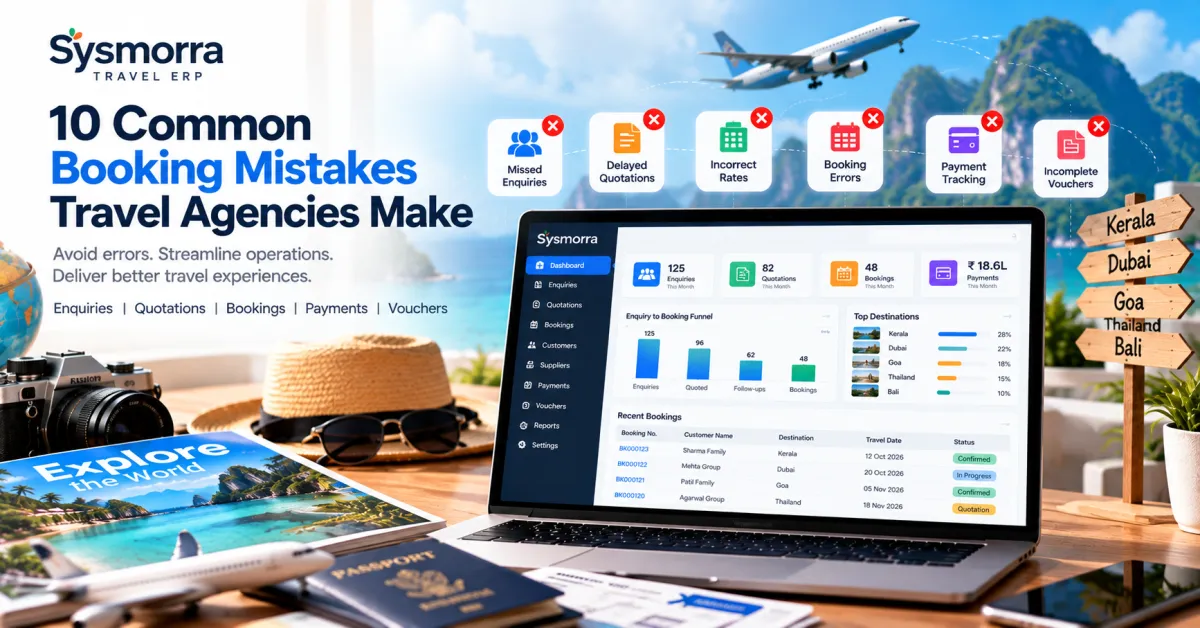
10 Common Mistakes Travel Agencies Make When Managing Bookings
Running a successful travel agency requires more than offering attractive destinations and competitive holiday packages. Behind every confirmed booking are several operational activities, including customer enquiries, quotations, hotel coordination, transportation arrangements, payments and travel documentation.
When these activities are managed manually, even experienced travel teams can make mistakes.
A missed enquiry, incorrect hotel rate or delayed payment confirmation can affect customer satisfaction and business profitability.
Understanding these common mistakes is the first step towards building a more organised travel business.
1. Not Tracking Every Customer Enquiry
Travel agencies receive enquiries through websites, phone calls, WhatsApp, social media and referrals.
When enquiries are handled through individual employees' phones or personal spreadsheets, some potential customers may never receive a proper follow-up.
How to improve: Maintain a centralised enquiry register with customer details, destination preferences, travel dates, assigned salesperson and follow-up status.
This helps the sales team identify pending enquiries and prioritise customer responses.
2. Taking Too Long to Send Quotations
Travellers often contact multiple agencies before finalising their holiday.
If preparing a quotation takes several hours or days, the customer may move forward with another agency.
Delays commonly occur when employees repeatedly search for hotel rates, calculate package costs and prepare documents manually.
How to improve: Maintain organised hotel and package information and use a structured quotation process to reduce repetitive work.
A faster response can improve the customer experience and help the agency remain competitive.
3. Sending Inconsistent Quotation Formats
Different employees may prepare quotations using different templates.
Some quotations may include detailed inclusions and exclusions, while others may omit important information such as cancellation policies or payment terms.
These inconsistencies can create confusion.
How to improve: Use a standard quotation format containing itinerary details, accommodation, transportation, inclusions, exclusions, pricing and booking conditions.
4. Incorrectly Calculating Package Costs
A travel package may include hotels, transportation, sightseeing, meals, taxes and additional services.
Errors can occur when rates change seasonally or when special holiday-period prices apply.
For example, a hotel may have one rate during the off-season and a higher rate during a festival or long weekend.
How to improve: Maintain updated supplier rates, verify applicable travel dates and review package calculations before sending the final quotation.
5. Not Maintaining Proper Customer Records
Repeat customers are valuable to travel agencies because they are already familiar with the business.
However, if previous booking details are scattered across files and messages, employees may struggle to access past customer information.
How to improve: Maintain organised customer and traveller records linked to previous enquiries and bookings.
This can help provide more personalised service during future travel planning.
6. Poor Coordination with Hotels and Transport Suppliers
A confirmed customer booking may involve multiple service providers.
If hotel reservations, vehicle arrangements and sightseeing services are not coordinated properly, last-minute operational problems can arise.
How to improve: Maintain supplier details, booking references, confirmation status and service requirements in a structured system.
7. Not Tracking Customer Payments Properly
Travel bookings frequently involve advance payments, instalments and final balances.
When payment information is maintained separately from booking records, finance teams may struggle to identify outstanding amounts.
How to improve: Link payment schedules, receipts and outstanding balances with the corresponding customer booking.
8. Preparing Travel Vouchers at the Last Minute
Hotel vouchers, cab vouchers and travel documents are important for a smooth customer experience.
Preparing them manually just before departure increases the risk of missing information.
How to improve: Prepare travel documents from confirmed booking details and review them before the customer's departure date.
9. Depending Entirely on WhatsApp Conversations
WhatsApp is useful for customer communication, but it should not be the only place where business information is stored.
Important confirmations, payment details and customer requests can become difficult to retrieve from lengthy conversations.
How to improve: Maintain official operational records within a centralised business system while using WhatsApp and email as communication channels.
10. Not Reviewing Business Performance
Many travel agencies focus on generating bookings but do not regularly analyse their operational performance.
Useful questions include:
-
How many enquiries were received?
-
How many quotations were sent?
-
How many enquiries converted into bookings?
-
Which destinations generate the most interest?
-
What customer payments remain outstanding?
How to improve: Use structured reports to review sales activity, booking performance and financial information.
How Travel ERP Software Can Help
A Travel ERP system connects important travel business processes.
A typical workflow may include:
Customer Enquiry → Quotation → Confirmation → Booking → Payment → Voucher → Reporting
Connecting these activities reduces duplicate data entry and helps different departments work with consistent information.
Introducing Sysmorra Travel ERP
Sysmorra Travel ERP is designed to help travel agencies and tour operators manage enquiries, quotations, bookings, customer records, payments, vouchers and related business activities through connected workflows.
Instead of relying on multiple spreadsheets and disconnected systems, travel businesses can use a more structured approach to everyday operations.
Build a More Organised Travel Business
Avoiding common booking mistakes does not require increasing administrative workload.
The right processes and tools can help travel agencies respond faster, maintain accurate records and provide better customer service.
Explore Sysmorra Travel ERP and discover a more connected way to manage your travel business.