GST Invoicing for Small Businesses in India: A Practical Guide
Goods and Services Tax (GST) is an important part of business accounting in India. For businesses registered under GST, maintaining accurate invoices and transaction records is essential for proper accounting and tax compliance.
Whether a business sells products, provides professional services or manages both, GST invoicing involves more than simply adding a tax percentage to a bill.
Businesses need to understand invoice requirements, applicable tax types, customer details, transaction records and the relationship between invoices and GST reporting.
This guide explains the fundamentals of GST invoicing and how structured accounting practices can make the process easier.
What Is a GST Invoice?
A GST tax invoice is a document issued by a registered supplier for a taxable supply of goods or services, subject to the applicable provisions.
It records important transaction information, including the supplier, customer, goods or services supplied, taxable value and applicable tax.
A properly prepared invoice helps businesses maintain accurate financial records and provides important documentation for tax reporting.
It may also support eligible recipients in claiming input tax credit, subject to the applicable conditions.
1. Understand the Different Types of GST
Businesses in India commonly encounter three major GST components.
CGST — Central Goods and Services Tax
CGST is the central tax component generally applicable to intra-state taxable supplies.
SGST — State Goods and Services Tax
SGST is the state tax component generally applicable alongside CGST to intra-state taxable supplies within a state.
IGST — Integrated Goods and Services Tax
IGST generally applies to inter-state taxable supplies and certain other transactions covered by GST law.
For example, consider a taxable supply of ₹10,000 with an assumed applicable GST rate of 18%.
For a typical intra-state transaction:
-
Taxable value: ₹10,000
-
CGST at 9%: ₹900
-
SGST at 9%: ₹900
-
Invoice total: ₹11,800
For a typical inter-state transaction:
-
Taxable value: ₹10,000
-
IGST at 18%: ₹1,800
-
Invoice total: ₹11,800
These examples are illustrative. Actual tax rates and treatment depend on the nature of the supply and applicable rules.
2. Include the Required GST Invoice Details
A GST invoice should contain the particulars applicable to the transaction under GST rules.
Commonly required information includes:
-
Supplier name, address and GSTIN
-
Unique invoice number
-
Invoice date
-
Recipient details and GSTIN, where applicable
-
Description of goods or services
-
Applicable HSN or SAC information
-
Quantity, where applicable
-
Taxable value
-
Applicable GST rate
-
CGST, SGST, IGST or other applicable tax amounts
-
Place of supply, where required
-
Other prescribed particulars
The precise requirements may vary depending on the transaction and the applicable GST provisions.
Maintaining a consistent invoice format helps reduce omissions and administrative errors.
3. Use Proper Invoice Numbering
Invoice numbers are important for identifying and tracking business transactions.
Under the applicable GST invoice rules, invoice numbering must follow the prescribed requirements, including uniqueness within the relevant financial year.
Businesses should maintain a consistent numbering system and avoid accidental duplication.
Accounting software can help manage invoice series and reduce manual numbering errors.
4. Understand HSN and SAC Codes
HSN codes classify goods, while SAC classifications are used for services.
These classifications help identify the nature of supplies for tax purposes.
The level of classification required on invoices depends on the applicable rules.
Businesses should verify the correct classification and tax rate rather than relying on assumptions or copying codes from unrelated invoices.
5. Maintain Accurate Customer GST Details
For business-to-business transactions, accurate customer GST information is important.
Incorrect GSTIN details or mismatched customer information can create reconciliation difficulties and may affect compliance processes.
Businesses should verify relevant customer details when creating or updating customer accounts.
A centralised customer master can reduce repeated data entry.
6. Understand Input Tax Credit
Input Tax Credit, commonly called ITC, allows eligible registered businesses to claim credit for qualifying GST paid on purchases, subject to statutory conditions.
Proper purchase invoices and supporting records are important for evaluating ITC eligibility.
However, possessing an invoice alone does not automatically guarantee that input tax credit is available.
Businesses must satisfy the applicable conditions and reconcile relevant purchase and tax information.
7. Know When E-Invoicing Applies
GST e-invoicing is a separate compliance process that applies to notified classes of taxpayers and specified transactions.
Under this process, applicable invoice information is reported to an authorised Invoice Registration Portal, which generates the required invoice reference and related details.
Not every small business is required to follow the e-invoicing system.
Businesses should check the current turnover threshold, exemptions, transaction coverage and reporting requirements before determining whether e-invoicing applies to them.
8. Avoid Common GST Invoicing Mistakes
Some common mistakes include:
-
Using an incorrect GST rate
-
Entering the wrong customer GSTIN
-
Applying the wrong tax type
-
Duplicating invoice numbers
-
Omitting required invoice details
-
Incorrectly classifying goods or services
-
Recording payments against the wrong invoices
-
Failing to reconcile accounting and GST records
A structured review process can help identify these issues before they affect reporting.
9. Connect GST Invoicing with Accounting
GST invoices are closely connected with business accounting.
A sales invoice may affect customer receivables, sales revenue and tax liabilities.
When these records are maintained separately, finance teams may need to enter the same information multiple times.
A connected accounting system can help maintain consistent transaction records.
A typical workflow may look like:
Customer → Sales Invoice → GST Calculation → Payment → Accounting → Reporting
This reduces unnecessary duplication and improves financial visibility.
10. Maintain Proper Records for GST Reporting
Accurate GST reporting depends on reliable transaction records.
Businesses should regularly review sales invoices, purchase records, credit notes, debit notes, tax classifications and relevant reconciliations.
Maintaining organised records throughout the reporting period is generally easier than correcting large numbers of transactions at the last minute.
Professional review remains important, particularly where transactions involve complex tax treatment.
How GST Invoicing Software Helps Small Businesses
Accounting software can help businesses organise invoice generation, customer information, tax calculations and financial records.
Depending on the software's capabilities, useful features may include:
-
Invoice templates
-
Customer and supplier records
-
Tax configuration
-
Sales and purchase registers
-
Payment tracking
-
Credit and debit notes
-
Financial reporting
-
Transaction history
The main advantage is maintaining connected business information rather than repeatedly transferring records between spreadsheets.
Introducing Sysmorra Accounting
Sysmorra Accounting is designed to support connected business accounting workflows.
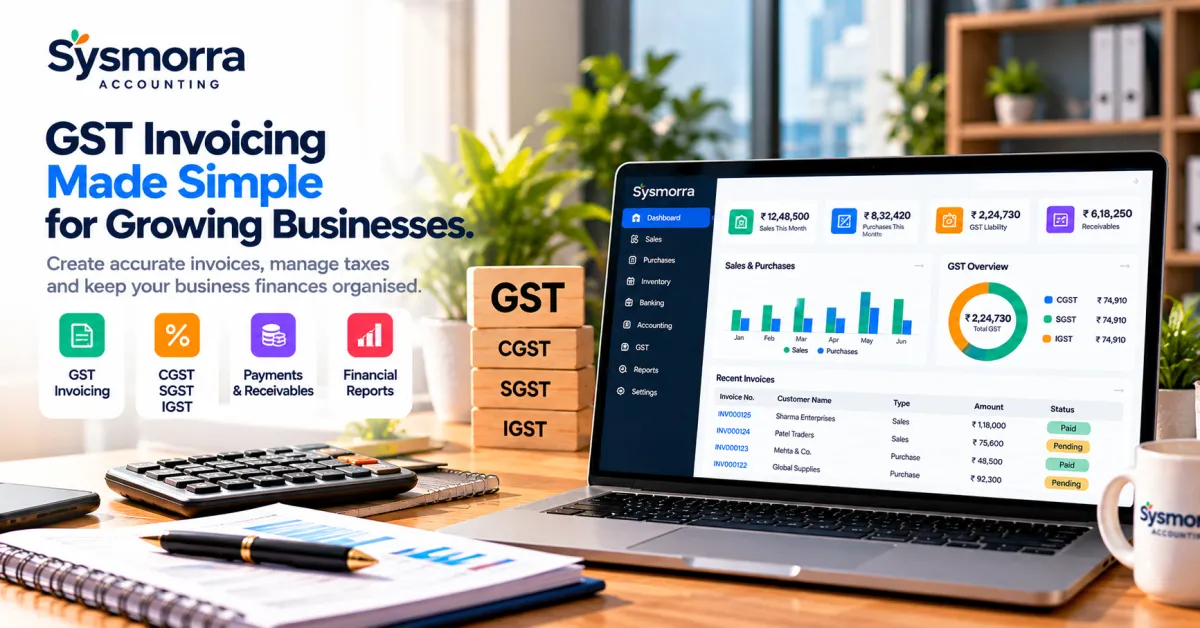
The platform brings together important activities such as customer records, sales invoicing, purchases, payments, banking, GST-related transaction records and financial reporting.
By organising everyday business transactions within a structured accounting system, businesses can reduce repetitive administrative work and maintain better financial visibility.
Software can assist with recordkeeping and calculations, but businesses should continue to verify tax treatment and compliance requirements with qualified professionals.
Simplify Your Business Invoicing and Accounting
Accurate invoicing is an important foundation for reliable business accounting.
By maintaining organised customer records, applying the correct tax treatment and connecting invoices with financial transactions, businesses can improve everyday accounting processes.
Explore Sysmorra Accounting and discover a more connected approach to invoicing, payments and business finance.