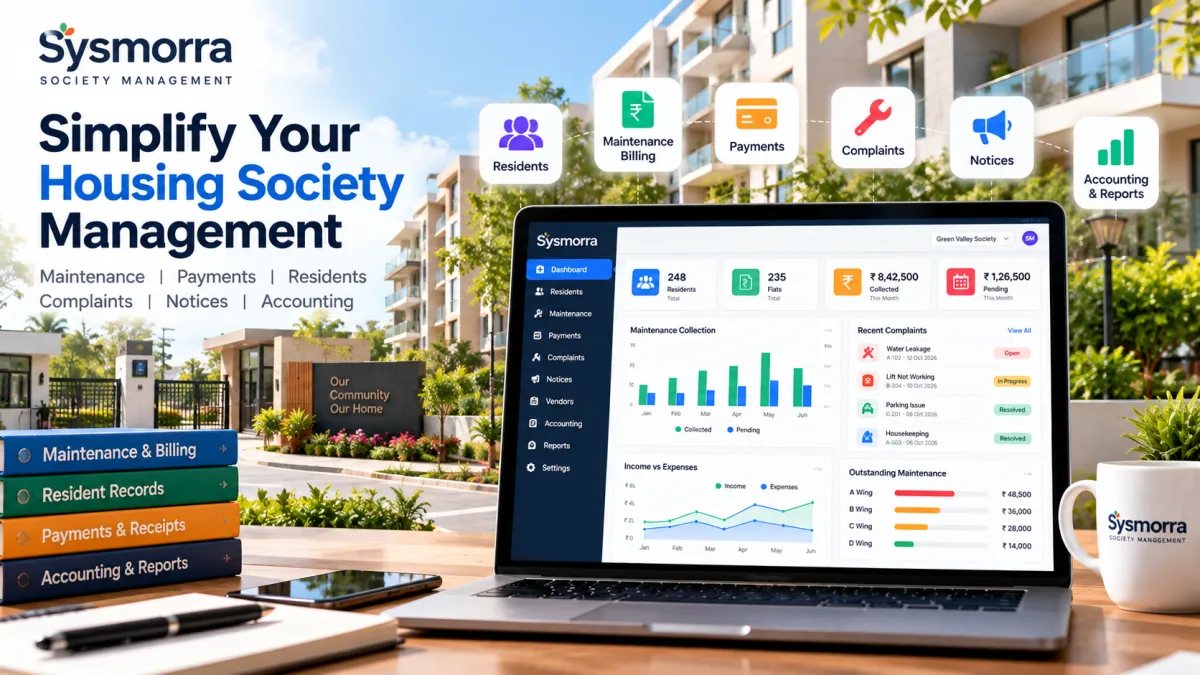
How Housing Society Management Software Simplifies Daily Operations
Managing a residential housing society involves much more than maintaining buildings and collecting monthly maintenance charges. Society committees must coordinate residents, manage finances, resolve complaints, maintain common facilities, communicate important announcements and ensure that day-to-day activities run smoothly.
For many housing societies in India, these responsibilities are still handled through spreadsheets, paper registers, WhatsApp groups and manual accounting records.
While these methods may work for smaller communities, they become increasingly difficult to manage as the number of residents, transactions and administrative activities grows.
Housing society management software provides a more organised approach by bringing important society operations into one connected digital system.
What Is Housing Society Management Software?
Housing society management software is a digital platform designed to help residential societies, apartment associations and community administrators manage everyday operations.
Depending on the platform, it may include:
-
Society and building information
-
Flat and resident records
-
Maintenance billing and collection
-
Payment receipts and outstanding balances
-
Society income and expenses
-
Resident complaints and service requests
-
Notices and announcements
-
Common facility management
-
Financial reporting
-
Committee administration
Instead of maintaining separate records for every activity, society management software helps organise information within a centralised system.
Why Housing Societies Need Digital Management
Consider a residential society with 150 apartments.
Every month, the managing committee may need to generate maintenance bills, record payments, follow up on outstanding amounts, manage vendor expenses, respond to complaints and communicate important updates.
When these activities are handled manually, the workload can become significant.
For example, a resident may pay maintenance through UPI, but the treasurer may still need to manually update the payment register and issue a receipt.
Similarly, a plumbing complaint received through WhatsApp may be difficult to track if several committee members are involved.
A connected management system can help reduce these administrative challenges.
1. Maintain Organised Resident and Flat Records
Accurate resident information is essential for effective society administration.
Housing societies often need to maintain details such as:
-
Building and wing
-
Flat number
-
Flat owner
-
Occupant or tenant
-
Contact information
-
Occupancy status
-
Relevant membership information
A structured resident database helps authorised committee members access important information without searching through multiple registers.
It can also make administrative updates easier when ownership or occupancy changes.
2. Simplify Monthly Maintenance Billing
Maintenance collection is one of the most important responsibilities of a housing society.
Charges may include common area maintenance, security, housekeeping, repairs, sinking fund contributions and other applicable charges.
Preparing bills manually for every flat can be time-consuming, particularly when charges differ according to flat size, category or approved society rules.
A society management system can help organise maintenance billing and maintain a clear record of charges assigned to each flat.
This makes it easier to track monthly collections and outstanding balances.
3. Track Payments and Outstanding Maintenance
Collecting maintenance charges is only one part of financial management.
Society administrators must also maintain accurate records of payments received and amounts still outstanding.
A structured payment system can help answer important questions:
-
Which flats have paid maintenance?
-
Which payments are pending?
-
Are there previous outstanding balances?
-
Has a payment receipt been issued?
-
What is the total amount outstanding?
Having this information organised helps the treasurer and managing committee review collection performance more effectively.
4. Improve Society Accounting and Financial Transparency
Residents contribute maintenance charges with the expectation that society funds will be managed responsibly.
A housing society may incur expenses for:
-
Security services
-
Housekeeping
-
Lift maintenance
-
Electricity for common areas
-
Water supply
-
Repairs and maintenance
-
Administrative services
-
Vendor payments
Maintaining accurate income and expense records helps the committee understand how society funds are being utilised.
Appropriate financial reports can also support budgeting, committee reviews, annual meetings and audits.
Transparent accounting builds confidence between residents and the managing committee.
5. Organise Resident Complaints and Service Requests
Every residential community receives maintenance-related complaints.
These may involve water leakage, lift problems, electrical faults, housekeeping, parking concerns or common-area repairs.
When complaints are handled only through phone calls or WhatsApp messages, tracking responsibility and progress can become difficult.
A structured complaint-management process can record the issue, assign responsibility and track its progress until resolution.
This provides better visibility for both residents and administrators.
6. Improve Communication with Residents
Effective communication is essential for a well-managed residential community.
Societies regularly share announcements about maintenance schedules, water supply interruptions, meetings, repair work and community activities.
A centralised communication process can help ensure important notices reach the intended residents.
Depending on the system and configured communication services, notices may be delivered through a resident portal, email, SMS or WhatsApp.
This reduces dependence on scattered messages and informal communication.
7. Manage Society Vendors and Common Services
Residential societies depend on several service providers.
These may include security agencies, housekeeping contractors, electricians, plumbers, lift maintenance companies and other vendors.
Maintaining organised vendor information helps committee members access contact details, service information and related administrative records.
This becomes particularly useful when committee members change or responsibilities are transferred.
8. Support Better Committee Administration
Housing society committees often consist of residents who manage administrative responsibilities alongside their professional and personal commitments.
A digital system can reduce the need to repeatedly prepare manual records or search through old documents.
Organised information also supports continuity when a new committee takes charge.
Instead of depending entirely on individual members to remember past activities, important operational information can remain accessible to authorised users.
9. Make Society Information More Accessible
Residents frequently contact committee members for maintenance statements, payment confirmations, notices and complaint updates.
A resident-facing digital platform can help provide access to relevant information without requiring repeated manual responses.
Role-based access is important so residents, committee members and administrators see only the information appropriate to their responsibilities.
This can improve convenience while supporting better information security.
10. Build a More Connected Residential Community
Society management is not limited to financial transactions.
A well-managed community also depends on communication, cooperation and access to essential services.
Digital platforms can help organise resident information, common service contacts, announcements and administrative activities.
As community requirements evolve, connected systems can provide a foundation for additional services that benefit residents and society administrators.
Moving from Manual Records to Digital Society Management
Transitioning to digital society management does not require every activity to change immediately.
A practical starting point is to organise the society's basic information and identify the most repetitive administrative tasks.
For many societies, the initial workflow may be:
Society Setup → Building & Flat Records → Resident Management → Maintenance Billing → Payment Collection → Accounting
Additional activities such as complaints, notices and vendor management can be introduced as required.
The objective is to reduce administrative complexity while improving the accuracy and accessibility of society information.
Introducing Sysmorra Society Management
Sysmorra Society Management is part of the Sysmorra business software ecosystem, designed to support organised and connected administration for residential communities.
The product vision focuses on bringing society records, resident administration, maintenance-related activities, financial management and community operations into a structured digital environment.
By reducing dependence on disconnected spreadsheets and manual registers, housing societies can work toward more efficient administration and better financial visibility.
Sysmorra aims to provide a practical software platform that supports both society administrators and the communities they serve.
Ready to Simplify Your Housing Society Management?
Managing maintenance collections, resident records, expenses and society communication should not require multiple disconnected systems.
Whether you manage a small apartment building or a larger residential community, a structured digital approach can help improve day-to-day administration.
Explore Sysmorra Society Management and discover how connected software can support more organised, transparent and efficient residential community operations.