Accounts Receivable vs Accounts Payable: A Complete Guide for Small Businesses
Managing business finances involves more than recording sales and expenses.
Every growing business needs to understand two important accounting concepts: Accounts Receivable (AR) and Accounts Payable (AP).
Accounts receivable represents money customers owe to the business, while accounts payable represents money the business owes to suppliers.
Although these concepts are closely related, they serve different purposes in financial management.
Understanding the difference helps business owners manage cash flow, track outstanding balances and make better financial decisions.
What Is Accounts Receivable?
Accounts receivable refers to amounts owed to a business by customers for goods or services supplied on credit.
For example, suppose a business provides services worth ₹50,000 to a customer and allows payment within 30 days.
Until the customer pays, the ₹50,000 is recorded as accounts receivable.
Accounts receivable is generally classified as a current asset when collection is expected within the normal operating cycle or the applicable current period.
Common Accounts Receivable Activities
-
Creating customer invoices
-
Recording credit sales
-
Tracking payment due dates
-
Receiving customer payments
-
Adjusting credit notes
-
Following up on overdue invoices
-
Preparing customer statements
-
Reviewing receivable ageing reports
Efficient receivable management helps businesses collect payments on time.
What Is Accounts Payable?
Accounts payable refers to amounts a business owes suppliers for goods or services purchased on credit.
For example, a business may purchase office equipment worth ₹30,000 from a supplier with payment due after 15 days.
Until the payment is made, the amount is recorded as accounts payable.
Accounts payable is generally classified as a current liability when it is due within the normal operating cycle or the applicable current period.
Common Accounts Payable Activities
-
Recording supplier bills
-
Maintaining vendor information
-
Tracking payment due dates
-
Verifying purchase invoices
-
Recording supplier payments
-
Managing credit notes
-
Preparing supplier statements
-
Reviewing payable ageing reports
Proper payable management helps businesses meet supplier commitments while managing available funds.
1. Accounts Receivable vs Accounts Payable: Key Differences
| Particulars | Accounts Receivable | Accounts Payable |
|---|---|---|
| Meaning | Money customers owe the business | Money the business owes suppliers |
| Accounting classification | Asset | Liability |
| Main transaction | Credit sales | Credit purchases |
| Related party | Customer | Supplier or vendor |
| Cash-flow impact | Future cash inflow | Future cash outflow |
| Main objective | Collect customer payments | Pay suppliers on time |
| Common report | Receivable ageing | Payable ageing |
Both are essential for maintaining an accurate picture of a business's financial position.
2. Example of Accounts Receivable
Consider a small business that sells goods worth ₹1,00,000 on credit.
The customer agrees to pay within 30 days.
At the time of the sale, the business records the amount receivable from the customer.
When the customer makes a payment of ₹60,000, the outstanding balance becomes:
₹1,00,000 − ₹60,000 = ₹40,000
The remaining ₹40,000 continues to appear as an outstanding customer balance until it is settled or otherwise adjusted.
This example assumes the amounts are the final invoice amounts and excludes additional adjustments.
3. Example of Accounts Payable
Suppose the same business purchases goods from a supplier for ₹75,000 on credit.
The supplier allows 20 days for payment.
The business initially records ₹75,000 as payable.
After paying ₹50,000, the remaining supplier balance is:
₹75,000 − ₹50,000 = ₹25,000
The business must track this outstanding amount and its due date.
Maintaining accurate supplier balances helps avoid missed payments and duplicate settlements.
4. Why Accounts Receivable Matters for Cash Flow
A business may report strong sales but still experience cash shortages.
This can happen when customers purchase on credit and delay payment.
For example, a business may generate ₹10 lakh in monthly sales but collect only ₹6 lakh during the same period.
The remaining ₹4 lakh may be tied up in customer receivables, assuming all sales were on credit and there are no other adjustments.
Although the business has generated revenue, it cannot use unpaid customer balances to meet immediate expenses.
This is why receivable management is important for cash-flow planning.
5. Why Accounts Payable Matters for Cash Flow
Accounts payable also affects working capital.
Businesses need to pay suppliers, service providers and other creditors according to agreed terms.
Paying every supplier immediately may reduce available cash unnecessarily when valid credit terms exist.
However, delaying payments beyond agreed dates can damage supplier relationships and may result in contractual or statutory consequences.
The objective is to maintain a reliable payment schedule that balances cash availability with business obligations.
6. Understand Receivable Ageing Reports
A receivable ageing report groups unpaid customer invoices according to how long they have remained outstanding.
For example:
| Ageing category | Outstanding amount |
|---|---|
| Not yet due | ₹1,20,000 |
| 1–30 days overdue | ₹65,000 |
| 31–60 days overdue | ₹30,000 |
| 61–90 days overdue | ₹15,000 |
| More than 90 days overdue | ₹10,000 |
| Total | ₹2,40,000 |
These figures are illustrative.
An ageing report helps businesses identify invoices requiring attention and prioritise collection follow-ups.
It can also support the assessment of credit risk and expected recoverability.
7. Understand Payable Ageing Reports
A payable ageing report shows outstanding supplier bills according to their due dates or overdue periods.
This helps finance teams identify upcoming payment obligations.
For example, a business may have:
-
₹80,000 due within the next 7 days
-
₹1,50,000 due within 30 days
-
₹40,000 already overdue
With this information, management can plan supplier payments more effectively.
Businesses should distinguish between invoices that are not yet due and those that are already overdue.
8. Common Accounts Receivable Mistakes
Small businesses frequently experience receivable problems because of inconsistent processes.
Common mistakes include:
-
Sending invoices late
-
Entering incorrect customer information
-
Not recording payment terms
-
Failing to follow up on overdue invoices
-
Recording payments against the wrong invoice
-
Maintaining duplicate customer accounts
-
Not reconciling receipts with bank records
-
Ignoring long-outstanding customer balances
A structured invoicing and collection process can help reduce these issues.
9. Common Accounts Payable Mistakes
Supplier payment management also requires proper controls.
Common mistakes include:
-
Recording duplicate supplier invoices
-
Paying bills without verification
-
Missing payment due dates
-
Recording expenses under incorrect accounts
-
Not matching supplier payments with invoices
-
Failing to account for supplier credit notes
-
Maintaining incomplete vendor records
-
Not reconciling supplier statements
These mistakes can lead to unnecessary expenses, inaccurate records and supplier disputes.
10. How AR and AP Affect Working Capital
Working capital is generally calculated as:
Working Capital = Current Assets − Current Liabilities
Accounts receivable contributes to current assets, while accounts payable contributes to current liabilities.
However, higher receivables do not necessarily mean a business has more cash available.
Similarly, higher payables may indicate future payment obligations.
Businesses should review receivables, payables, inventory and cash balances together when evaluating working capital.
11. Best Practices for Managing Accounts Receivable
Businesses can improve customer collection processes by following several practical steps.
Create invoices promptly. Issue accurate invoices according to the agreed transaction terms.
Define clear payment terms. Communicate due dates and accepted payment methods.
Maintain customer ledgers. Record invoices, receipts, credit notes and adjustments consistently.
Review outstanding balances. Monitor overdue invoices and follow up professionally.
Reconcile payments. Match bank receipts with the appropriate customer invoices.
Monitor ageing. Identify long-overdue balances and review collection risks.
These practices help maintain reliable receivable records.
12. Best Practices for Managing Accounts Payable
Supplier payment management benefits from equally structured processes.
Maintain accurate supplier records. Keep relevant vendor information organised.
Verify supplier bills. Confirm invoice details and supporting documentation.
Track due dates. Maintain visibility into upcoming payment obligations.
Avoid duplicate payments. Use invoice references and approval controls.
Record payment allocations. Match each payment to the correct supplier bill.
Reconcile supplier balances. Review statements and resolve discrepancies.
These practices support better financial control and supplier relationships.
13. How Accounting Software Simplifies AR and AP
Managing customer receivables and supplier payables through separate spreadsheets can become difficult as transaction volumes increase.
Accounting software can help organise both activities within a connected system.
A typical receivable workflow is:
Customer → Sales Invoice → Receivable → Payment Receipt → Reconciliation
A typical payable workflow is:
Supplier → Purchase Bill → Payable → Supplier Payment → Reconciliation
Connected records reduce repetitive data entry and make financial information easier to retrieve.
Depending on the platform, accounting software may also support:
-
Customer and supplier ledgers
-
Invoice and bill management
-
Payment allocation
-
Outstanding statements
-
Ageing reports
-
Bank reconciliation
-
Financial reporting
-
Transaction histories
-
Approval controls
14. Why Financial Visibility Matters
A business owner should be able to answer several important questions:
-
How much money do customers owe us?
-
Which customer invoices are overdue?
-
How much do we owe suppliers?
-
Which supplier payments are due this week?
-
What cash is available for upcoming obligations?
-
Are recorded balances consistent with bank transactions?
When financial information is scattered across multiple files, answering these questions may require significant manual effort.
A connected accounting system helps provide a more organised view of financial operations.
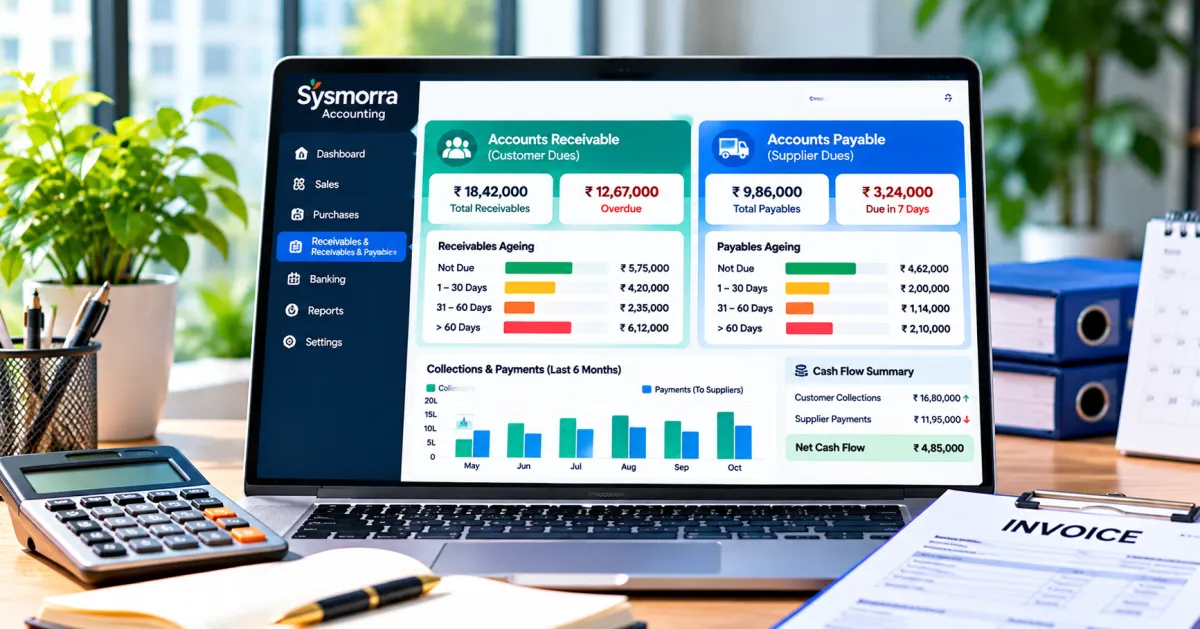
Introducing Sysmorra Accounting
Sysmorra Accounting is designed to support connected financial workflows for growing businesses.
The platform brings together important accounting activities, including sales, purchases, customer receivables, supplier payables, banking, payments and financial reporting.
By maintaining customer and supplier transactions in a structured system, businesses can improve financial visibility and reduce dependence on disconnected spreadsheets.
Take Better Control of Your Business Finances
Accounts receivable and accounts payable are two essential components of everyday business accounting.
Managing both effectively helps businesses collect customer payments, meet supplier obligations and maintain more reliable financial records.
The objective is not simply to record transactions, but to understand how outstanding amounts affect the business.
Explore Sysmorra Accounting and discover how connected receivable, payable and financial workflows can support better business management.