How to Create Professional Travel Quotations That Convert More Enquiries into Bookings
Preparing a travel quotation is one of the most important activities in a travel agency's sales process.
A customer may contact several travel agencies before selecting a holiday package. While price is an important consideration, the clarity, presentation and completeness of the quotation can also influence the customer's decision.
A professional travel quotation should do more than display the package cost.
It should help the customer understand the travel experience, accommodation options, services included, payment requirements and booking conditions.
This guide explains how travel agencies can create better quotations and improve their enquiry-to-booking process.
What Is a Travel Quotation?
A travel quotation is a formal proposal prepared by a travel agency or tour operator for a prospective customer.
It outlines the proposed travel arrangements and estimated or confirmed package pricing, depending on availability and booking conditions.
A typical travel quotation may include:
-
Destination and travel dates
-
Number of travellers
-
Hotel and room details
-
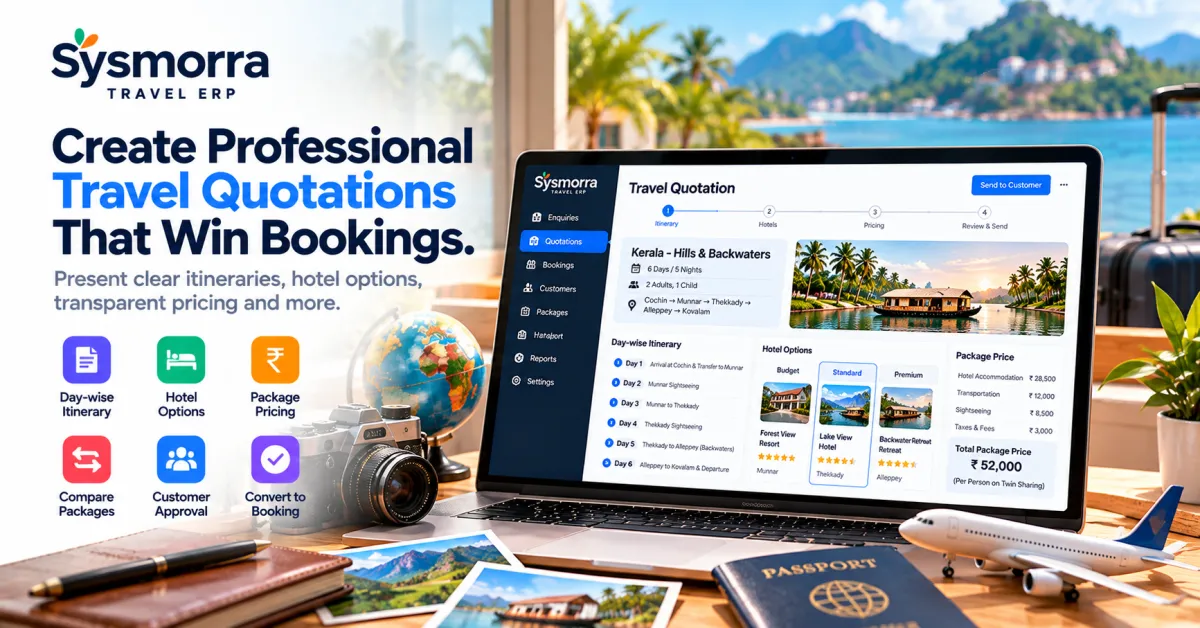
Day-wise itinerary
-
Transportation arrangements
-
Sightseeing activities
-
Package inclusions
-
Package exclusions
-
Total package price
-
Payment terms
-
Cancellation conditions
-
Quotation validity
A well-structured quotation helps customers compare options and make informed decisions.
1. Understand Customer Requirements Before Preparing a Quote
The quality of a quotation depends on understanding what the customer actually wants.
Before preparing a proposal, collect essential information such as:
-
Preferred destination
-
Travel dates
-
Number of adults and children
-
Number of rooms
-
Preferred hotel category
-
Approximate budget
-
Transportation requirements
-
Special preferences
For example, a family travelling with young children may prefer a relaxed itinerary, while a group of friends may prioritise sightseeing and activities.
Understanding these preferences helps the agency recommend more relevant travel arrangements.
2. Present a Clear Day-Wise Itinerary
A travel quotation should explain what the customer can expect during the trip.
Instead of providing only a list of destinations, prepare a structured day-wise itinerary.
For example:
Day 1 — Arrival and Hotel Check-in
Arrival at the destination, transfer to the hotel and leisure time.
Day 2 — Local Sightseeing
Visit the sightseeing locations included in the proposed package.
Day 3 — Departure
Check out from the hotel and transfer to the departure point.
The itinerary should clearly distinguish included services from optional activities.
Avoid promising sightseeing or experiences that have not been included in the package arrangements.
3. Offer Suitable Hotel Alternatives
Accommodation is often one of the most important factors influencing a holiday booking.
Customers may have different expectations regarding comfort, location and price.
Where suitable options are available, a travel agency can offer alternatives such as:
-
Budget accommodation
-
Standard hotels
-
Premium hotels
-
Luxury accommodation
Each option should clearly mention the hotel name or category, room type, meal plan and relevant conditions.
This allows customers to compare choices without repeatedly requesting entirely new quotations.
4. Explain Package Inclusions Clearly
Customers should know exactly what is included in the quoted price.
Typical inclusions may involve accommodation, selected meals, transfers, sightseeing transportation and other agreed services.
A clear inclusion section reduces uncertainty and helps establish realistic expectations.
For example:
Package Inclusions
-
Accommodation for the specified number of nights
-
Meals according to the selected plan
-
Transportation as mentioned in the itinerary
-
Sightseeing included in the programme
-
Applicable services specifically mentioned in the quotation
The agency should include only services that it can actually provide under the quoted arrangements.
5. Mention Exclusions Transparently
Exclusions are just as important as inclusions.
Customers may assume that every activity or expense is covered unless the quotation states otherwise.
Common exclusions may include personal expenses, optional activities, additional meals, entry tickets or services not specifically included.
Clearly identifying exclusions helps prevent disputes and unexpected costs during travel.
6. Calculate Package Pricing Carefully
Travel package pricing may involve several components.
These can include hotel rates, transportation charges, sightseeing costs, supplier charges, taxes and the agency's markup.
Prices may also change depending on travel dates, room occupancy and seasonal demand.
For example, a hotel may offer different rates during off-season periods, weekends, festivals and peak holiday dates.
Agencies should verify the applicable supplier rates before finalising a quotation.
A structured pricing process can help reduce calculation mistakes.
7. Make Quotations Easy to Compare
When customers request multiple package options, presenting the differences clearly can simplify their decision.
A comparison may include:
| Feature | Standard Package | Premium Package |
|---|---|---|
| Accommodation | Standard hotel | Premium hotel |
| Room category | Standard room | Upgraded room |
| Meal plan | As quoted | As quoted |
| Transportation | As quoted | As quoted |
| Sightseeing | Included itinerary | Included itinerary |
| Price | Based on selected services | Based on selected services |
Actual differences should be clearly identified rather than implied.
A simple comparison can reduce repeated customer questions.
8. Use a Professional Quotation Format
Presentation affects how easily customers understand a proposal.
A professional quotation should include the travel agency's name, contact details, customer information and a clearly structured package description.
Use consistent headings, readable fonts and appropriate spacing.
Avoid overly crowded layouts or long paragraphs that make important details difficult to find.
The objective is to make the quotation easy to review on both desktop and mobile devices.
9. Mention Payment and Cancellation Conditions
Travel quotations should clearly explain important booking conditions.
These may include:
-
Advance payment requirements
-
Balance payment deadlines
-
Quotation validity
-
Booking confirmation conditions
-
Cancellation charges
-
Refund conditions
-
Supplier-related restrictions
These details help customers understand their financial commitments before confirming a booking.
Where rates or availability are not guaranteed, the quotation should state that clearly.
10. Follow Up at the Right Time
Sending a quotation does not always result in an immediate booking.
Customers may need time to discuss travel plans with family members or compare different options.
A professional follow-up process can help the agency remain available without overwhelming the customer.
Useful follow-ups may include clarifying hotel alternatives, explaining the itinerary or answering questions about payment terms.
The goal is to assist the customer in making a decision rather than applying unnecessary pressure.
How Travel Quotation Software Helps
Preparing quotations manually can become time-consuming when a travel agency handles many enquiries.
Travel quotation software can help organise package components, pricing information and customer proposals.
Depending on the system, it may support:
-
Quotation creation
-
Hotel and package options
-
Itinerary preparation
-
Pricing calculations
-
Multiple quotation alternatives
-
Customer information
-
Quotation revisions
-
Booking conversion
-
Payment information
A connected workflow can reduce duplicate work between sales and booking operations.
From Enquiry to Confirmed Booking
A typical travel sales process may look like:
Customer Enquiry → Requirement Analysis → Quotation → Customer Review → Confirmation → Booking → Payment
When these activities are connected, the agency can maintain better visibility into the status of each enquiry.
Sales teams can focus on customer requirements while booking teams receive more consistent information after confirmation.
Introducing Sysmorra Travel ERP
Sysmorra Travel ERP is designed to help travel agencies and tour operators manage the travel sales and booking lifecycle through connected workflows.
The platform supports structured enquiry management, travel quotations, package information, customer records, booking operations, payments and travel documents.
By bringing these activities together, travel agencies can reduce repetitive administration and provide a more organised customer experience.
Create Better Quotations. Win More Bookings.
A professional travel quotation is more than a price proposal.
It is an opportunity to demonstrate the agency's understanding of the customer's requirements and provide confidence in the proposed travel arrangements.
Clear itineraries, transparent pricing, suitable accommodation options and timely follow-ups can help customers make informed booking decisions.
Explore Sysmorra Travel ERP and discover how connected quotation and booking workflows can support your travel business.